Roland Keefer
The Caine MutinyRoland Keefer is Tom Keefer’s brother, Willie Keith’s former roommate, and a naval officer whose wartime service culminates aboard the carrier Montauk. Introduced as an exuberant, joking presence at Furnald Hall Midshipmen School, he later appears in a brief reunion with Willie and Tom before the news of his death reveals the seriousness of his work: when his ship’s command and communications fail during an attack, he takes charge of damage control and helps restore order. His story turns an old roommate’s casual promise to meet again into a final encounter, and tests his comic confidence against the danger of combat.
Identity and School Years
Roland first enters the novel under a heap of books that tumbles into a shared room and reveals a tall, heavyset sailor with a cheerful face and a pronounced Southern cadence. He introduces himself simply as Keefer. His joking manner establishes an immediate contrast with the anxious, effortful atmosphere of the men’s training: where classmates fret over study and examinations, he meets the burden with humor.
His academic record is uneven. He often fails tests, but calculates his averages carefully enough to remain above the estimated level for expulsion. His particular strength is military judgment. Despite an outwardly slovenly appearance, he is described as the most polished seaman in the school; he keeps himself, his bed, and his books in careful order. On parade, a neat uniform, shining shoes, and erect bearing distinguish him, and he is appointed a battalion commander. The contrast is characteristic: Roland may look careless, but his discipline and professional ability are not superficial.
His sociability also appears in a later visit to Club Tahiti, where he arrives through the crowded room in a disheveled state, towing a companion. He greets Willie Keith with familiar jokes, then turns respectfully to May Wynn before returning to his teasing. The scene presents him as an energetic, irreverent friend, but also as someone capable of adjusting his manner to the people around him.
Choosing a Naval Posting
When the trainees are asked to rank their preferred duties, Roland chooses Staff Duty in the Pacific. He imagines a relatively comfortable posting in Hawaii, with occasional errands for an admiral, and leaves his other choices blank rather than disguising his preference. His candid response differs from the carefully calculated requests of classmates, who try to predict how the Navy will interpret their forms. At graduation he receives the Pacific staff assignment he wanted and celebrates the news exuberantly, only to notice that Ed Keggs is trembling beside him with his own orders still unopened.
The assignment reflects Roland’s early, comic view of the war as something one might navigate toward the most agreeable available station. The novel does not present his initial preference as a settled account of his later service. Instead, it eventually places him aboard Montauk, where he is responsible for damage control. The gap between his hopeful choice and the danger of his later duty gives his story its quiet reversal: the man who joked about finding an easy corner of the war proves capable when he cannot avoid its demands.
Friendship and Reunion at Sea
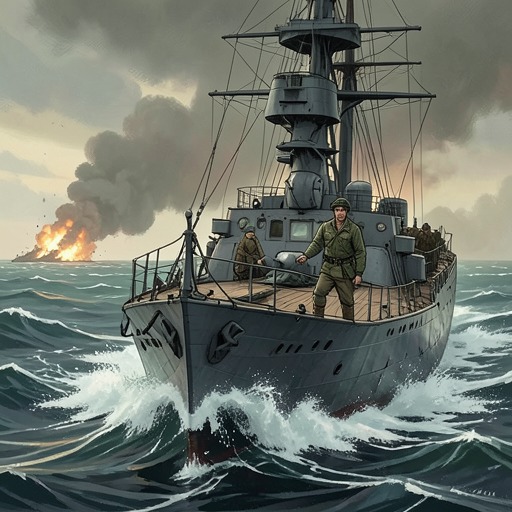
Roland’s connection to the central group is first made explicit when Tom recognizes the name of Willie’s ship, USS Caine, and suspects that his brother may be serving aboard it. The brothers are not together there: Roland is later seen aboard Montauk as the carrier passes USS Caine. From the gun tub he waves a green megaphone toward Tom, while Willie identifies him through binoculars. The ships move past one another too quickly for a full conversation; only fragments of Roland’s shouted greeting carry across the water. Tom answers that Roland can tell him about the war next time.
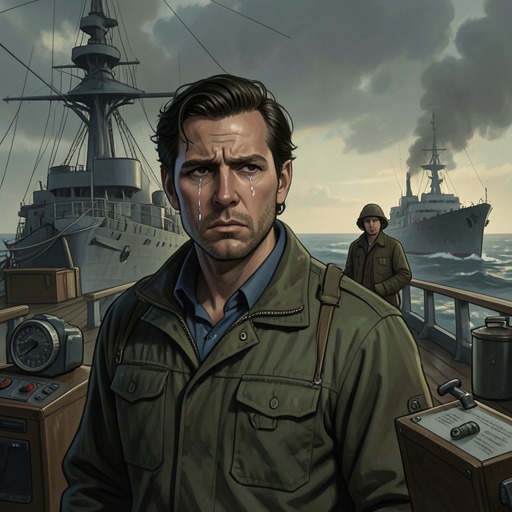
That anticipated next meeting never comes. When a boat from Montauk later reaches USS Caine, the officer it brings is not Roland but a young ensign, who tells Tom that his brother died the previous day and was buried at sea. Tom receives the news calmly on the surface, invites the ensign below, and offers coffee. Willie, who has known Roland since their school days, remains with him after the visitor leaves. The ordinary acts of hospitality and friendship frame the revelation without making it less final: the promised conversation about the war has become a report delivered by a stranger.
Damage Control and Death
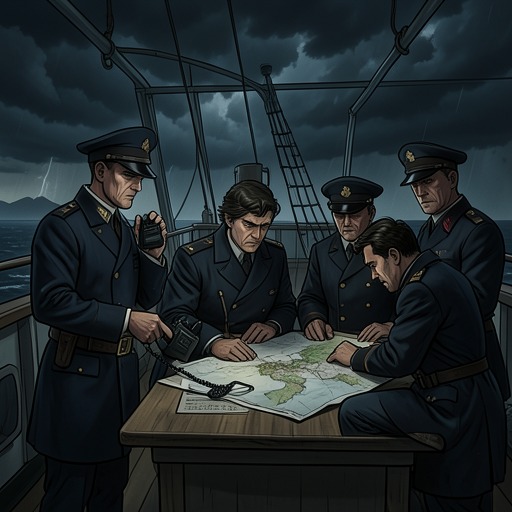
The ensign explains that Roland was the damage-control officer aboard Montauk. When fires broke out and the ship’s bridge and ordinary command arrangements were disabled, Roland took over. He connected a gasoline-powered generator to restore communications, directed firefighting over the loudspeakers, and ordered measures to protect the ship, including flooding magazines and using its fire-control systems. When the steering engine room could not receive orders, he also began conning the carrier, going out to assess what lay ahead.
After debris fell on him, Roland was badly injured, but continued directing the response and steering the ship while other sailors assisted him. When a senior surviving officer emerged and assumed command, Roland was taken to sick bay. The ensign later found him still engaged with the work: Roland had him read a damage-report dispatch aloud and instructed him how to correct it. His attention remained on the report even while he was weak and receiving treatment. He died after pneumonia followed his burns. The restrained account emphasizes the sequence of responsibility—restoring communications, directing the crew, and continuing until another officer could take over—rather than turning his death into spectacle.
Character and Narrative Significance
After hearing what Roland did, Tom does not dwell only on grief. He observes that his brother performed well and wonders whether the military-school upbringing that had shaped him had its value. Willie agrees that Roland acted exceptionally well. Their exchange links the schoolroom record—his polish, command, and practical military sense—to the qualities he displays under pressure. The novel does not claim that good training guarantees courage; it shows Roland’s competence in a specific emergency, as reported by the officer who served with him.
Roland’s brief appearances also provide a counterpoint to the long, repetitive strains of service aboard USS Caine. Elsewhere, naval life is marked by watches, paperwork, uncomfortable quarters, and tasks that can seem distant from combat. Roland’s account is different: it brings into view the immediate consequences of a ship under attack and the coordinated labor required to keep it functioning. His death makes that contrast personal for Tom and Willie, who had known him first as a roommate and comic companion, not as a name in a casualty report.
The novel’s prefatory note identifies the people and events aboard USS Caine as imaginary and cautions that historical details and naval procedures have been altered. Roland should therefore be read as a fictional figure in a World War II setting, not as a portrait of a real officer. Within that fiction, his arc is deliberately compact but complete: a confident young man chooses the duty he hopes will be comfortable, finds himself responsible in a crisis, and dies after helping his ship’s crew regain control.